

Wozzeck’s Descent into Madness
What is human dignity?


Wozzeck, a struggling soldier, is by his own account, a simple man: all he wants is to provide for his family, live with dignity, love, and be loved. I say simple because his are the most elemental of human needs. Trapped and living in abject poverty, he is forced to work menial tasks by his bullying commanding officer, who pressures him into bizarre medical experiments to make ends meet. He grows suspicious that his beloved common-law wife Marie may be cheating on him with a handsome Drum Major, from his regiment. Imprisoned by his own mind, he is struggling with terrifying hallucinations: imagining a decapitated head rolling along a forest floor behind the backdrop of a blood-red glow in the evening sky. Desperate to break free from the web of cruelty, deprivation and mental imprisonment, the harder he tries to escape, the tighter the noose draws around his neck. He finds himself increasingly isolated by the casual cruelty of his military and medical commanders, until in his final act of desperation, he is compelled to destroy the only thing he truly loves, under the gaze of the crimson moon.
Wozzeck’s opera is adapted from Georg Büchner’s play of Woyzeck, based on a true story about the case of an ex-soldier, Johann Christian Woyzeck, who murdered his mistress. The play revolves around Wozzeck’s increasing paranoia and hallucinations cloaked in a deep pessimism about humanity and the bleakness of existence. The opera depicts Wozzeck as a victim of rigid social structures and their oppressive figures, exploring themes of exploitation, psychological breakdown, and social injustice. It is a grim and vivid portrayal of psychosis in juxtaposition to a society that fuels poverty, the cruel and fickle whims of authorities, medical malpractice, and romantic betrayal to drive a common man to destruction.
Upon seeing the Viennese premiere of the play in 1914, Alban Berg decided to set it to music. The music is strategically and methodically as depressing as the play, composed to heighten the musical and dramatic connections, with the dialogue in the play left unchanged. Consider how this plays out. In Act I, Wozzeck is shaving the Captain, when the officer dictates that he should work more slowly, telling him that he is a “good man, but lacks morality” because he has an illegitimate child with his wife, Marie. Wozzeck retorts that human beings are “flesh and blood” pointing out that virtue is a luxury the poor cannot afford, as they are consumed by the daily struggles of staying alive. Consumed by psychosis and visions, Wozzeck begins to see them as an omen of evil things to come. Desperate to silence them, he visits the Doctor, who lures him with pennies into bizarre medical experiments, obsessed with the idea of making grand medical discoveries. When he brings up hallucinations, the doctor dismisses them as only his imagination. Meanwhile, the handsome Drum Major flirts with Marie, who resists at first, but gives in to his advances. In Act II, the Captain and the Doctor are nonchalantly discussing sickness and death as if remarking what they had for breakfast. When Wozzeck passes by, they mock and jeer him by alluding to Marie’s infidelity. Shocked, Wozzeck defends his love for Marie and rushes off to confront her. When he threatens her, she remains defiant, telling him that she would rather die than have his hands on her. His psychosis now consumes him, with blood-covered people dancing the waltz in his deteriorating mind. In Act III, Marie is consumed by guilt. To absolve herself of her sins, she reads the Bible to her child, begging God for mercy. When she sees Wozzeck, they are near a pond, where he kisses her as he makes sarcastic remarks about her fidelity. When she tries to escape, he draws a knife and kills her. His delusions of blood-stained people dancing the waltz consume him. He throws the knife into the water, but he becomes terrified that the moon will reveal his crime so he throws himself into the water to look for it, thinking that the water will wash the blood off of his hands. The Doctor and Captain pass by, callously hearing him struggling in the water, but they don’t offer to help him. He drowns. In the final scene, whilst playing in the street, the neighbours tell Marie’s son that his mother is dead. The child does not understand. He keeps playing.
Whilst Berg’s Wozzeck is not explicitly a critique of totalitarianism, it describes the seed that breeds it precisely, by depicting the individual’s psychological, economic, and physical destruction within a repressive, insular, and dehumanizing society. It explores the destructive potential of unchecked power, lack of accountability, egoism, narcissism, social control, and the erosion of the rights of the person. All of it resonates with totalitarianism’s impact on human life. In being subjected to constant abuse and manipulation by his superiors, the Captain and the Doctor represent a system in which individuals are treated as expendable tools rather than as human beings. It ultimately reduces individuals and the relationships between them, to cogs in a machine.
Wozzeck’s ultimate descent into madness is a consequence of the system’s attempt to strip him of his individuality and force him to conform to their rigid demands. This is totalitarianism at its root: it seeks to control, to dehumanize, to moralize, and to politicize every aspect of life, including thoughts and emotions, leading to a loss of personal identity. When rulers cloak cruelty, an incapacity for self-reflection, and a lack of remorse in the language of virtue, genuine compassion can become extinguished even in ordinary people who believe themselves to be acting morally. A society becomes malignant when the freedom to exist, to think for oneself, and to individuate becomes contingent on permission. The opera highlights the stark inequalities of Wozzeck’s society, where the wealthy, privileged, and powerful exploit the weak, poor, and vulnerable. It resonates, precisely, with the totalitarian regimes of today. It creates a hierarchy where dissent is crushed and where society becomes coercive rather than humane, so that those in power can maintain their power through force, grandstanding, moralizing and manipulation. This very depressing opera explores precisely the devastating psychological and economic impact of living under such conditions. Wozzeck’s increasing anxiety, paranoia, delusions, eventual psychosis, and destruction demonstrate the mental toll of living in a society where one feels constantly threatened and controlled and why escaping such conditions is paramount. The opera’s enduring power, however depressing, lies in its ability to connect the dangers of unchecked control with the idea that foundational freedoms are inalienable because they are granted to us by God, and that no man has the authority to take away what God has given. In doing so, it underscores the importance of human dignity. Wozzeck’s dignity doesn’t disappear because he is poor, mentally ill, humiliated, or morally compromised. The horror is that everybody around him behaves as if he has none.
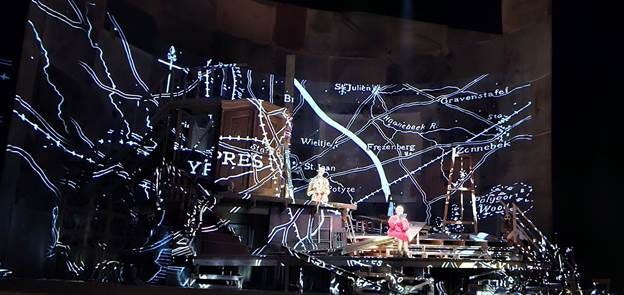
In this scene in Act III, Marie sits alone with her son depicted as a puppet, devastated by her guilt over her infidelity with Drum Major, she reads the Bible aloud, begging for mercy and forgiveness. The interesting projection in the background features a hand drawn map of a battlefield used to create a feeling of psychological weight and impending doom.