


Part of a series on America’s 250th Anniversary of Independence, and originally published in the C2C Journal: Ideas that Lead, I am thrilled to share my latest article in full for you below.
With another Canada Day having passed, it’s a good time to reflect on the patriotic fervour sweeping the country. In P.M. Szpunar’s estimation, much of it is nothing to be proud of. From performative “Buy Canadian” campaigns to booing U.S. children on visiting sports teams, too many Canadians have responded to American swagger with self-righteous sneering, assuring themselves their country is wiser, kinder and more civilized. This even as the southward flow of Canadian money, talent and innovation accelerates. Self-indulgent anti-Americanism is not just lazy and immature, argues Szpunar, it’s counter-productive, distracting Canadians from the real work of addressing our own weaknesses and rebuilding our strengths. A serious country should want better.
Grocery shopping on a beautiful Friday night not long ago, I couldn’t find celery, so I asked a clerk about it. “Oh, let me bring you some!” he exclaimed, uneasily. He returned visibly embarrassed, because all he had to present was the most pitiful and emaciated stalks I’d ever seen. Celery wasn’t the only thing missing; the produce section’s shelves were largely empty. I couldn’t shake the unsettling sight, so I asked another employee whether Friday was re-stocking night. “Oh no,” she said. “We’re getting a lot of pressure from customers, including emails, to boycott American produce.” “How many customers?” I asked. “Around 30 percent of our regular traffic,” she said. “Apparently at Loblaw’s, it’s even worse.”
For a moment, I had nothing to say. “I’m sorry,” I finally managed. “Some people just want to eat real food.” I left without those $5 miniature celery stocks but with the absurdity sitting like a doughy lump in my stomach. For over a year, I’ve longed for delicious and just-harvested greenhouse-grown veggies from a specialty market, but I just can’t afford that. So here I am, a Canadian, on a limited budget, and fellow Canadians have made it impossible to purchase fresh food that’s affordable.
I’m not the only customer leaving stores empty-handed, because such anti-American behaviour is widespread. A year back, the Angus Reid polling firm found that 85 percent of Canadians had replaced or planned to replace U.S. products in their purchases, and 59 percent said they would boycott American imports outright. Yet long after “Elbows Up” was laid bare as a cynical election ploy, people are still at it. And grocery stores are willing to oblige.
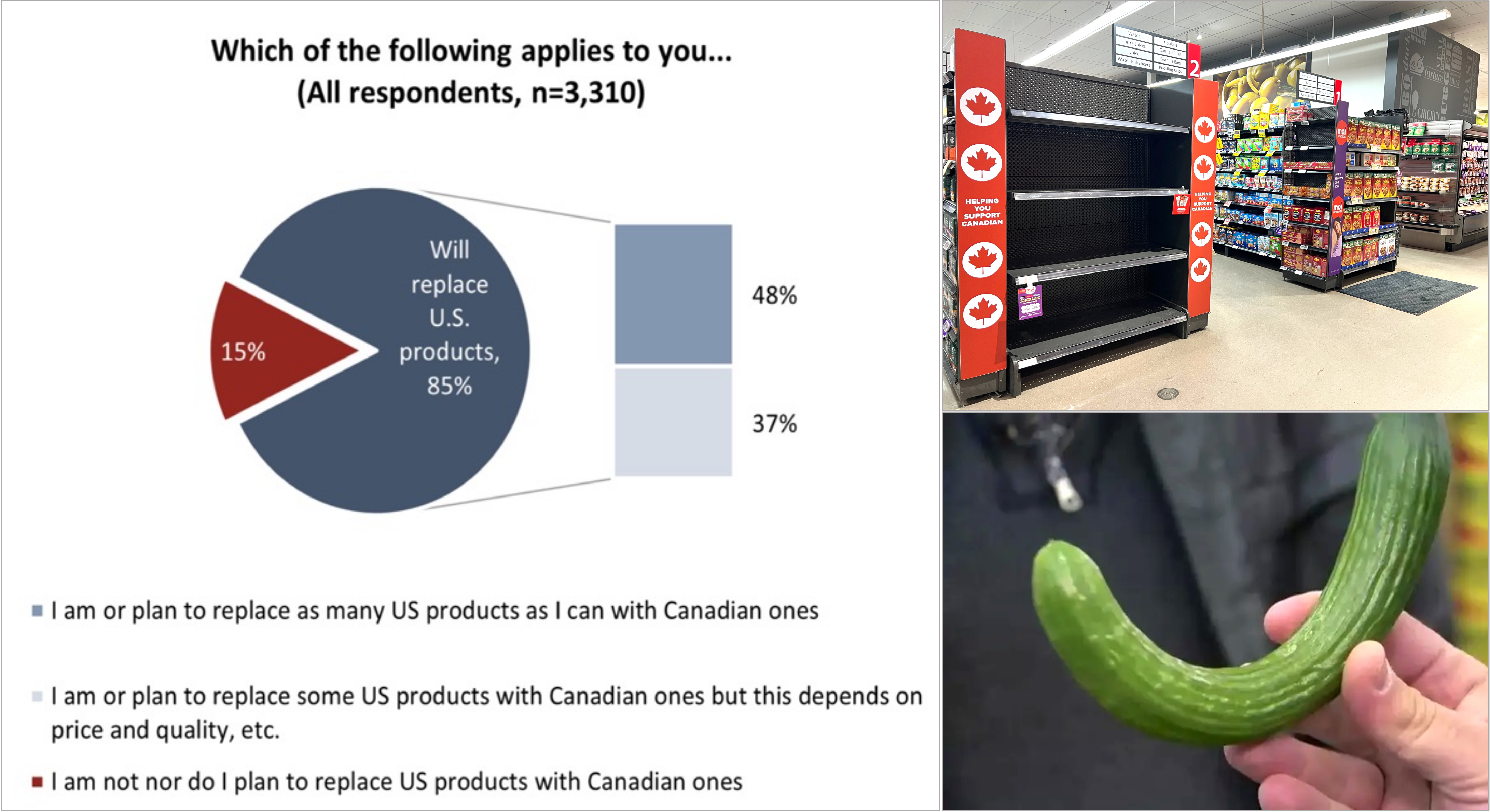
Denying shoppers the best-priced goods for political reasons strikes me as part of a larger racket. Global News reported that Loblaw’s had weighed packaging together with food, thus overcharging customers. Other tricks have included taking formerly loose lemons, onions or avocadoes and selling them in bundles, or obfuscating unit pricing in packages of convenience, otherwise known as “shrinkflation”. A cucumber can be transformed into a “snacking solution,” with the customer paying premium for plastic, slicing and the emotional relief of not having to use a knife. Prices remain emotionally familiar whilst quantities disappear as grocers are forced to play magic tricks in order to stay alive.
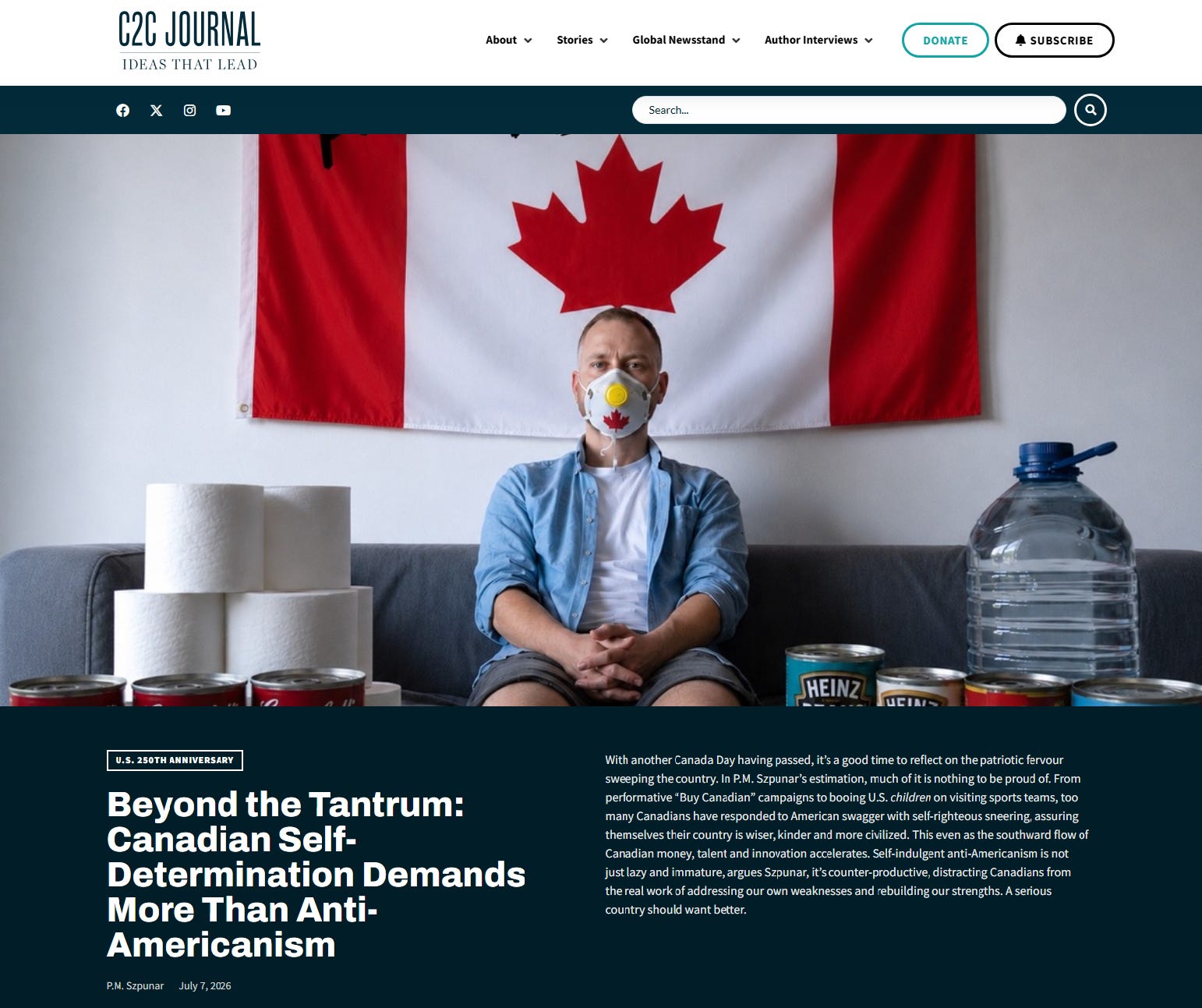
Food shortages and zooming prices are more than an inconvenience – they’re a warning sign. Not because you can’t find pecorino cheese for Jamie Oliver’s Summertime Tagliarini. But because scarcity has a way of turning consumers into zealots. The moral panic accompanying “Buy Canadian” is not unlike the obsession with toilet paper during the “Great toilet paper scare of 2020”.
For shoppers who think they’re both signaling and bolstering national loyalty through grocery choices, the problem is that supply chains are as tightly integrated as a car’s engine. Slapping on a maple-leaf sticker won’t unwind such complexity. Irrespective of whether the product is American, imported or “prepared” in Canada, it asks those “Elbows Up” consumers to patrol grocery aisles like hyper-vigilant border agents on the hunt for smuggled goods. The patriotic profiteering they’re attempting to root out even gets its own inflammatory label: “maple washing”.

The Canadian Food Inspection Agency last year reported finding 12 cases of maple washing, where food baldly labelled “Canadian” was found to be imported. Shoppers were aghast to find “domestic” asparagus with a small tag from Peru. Worse, the Peruvian asparagus was distributed by a U.S. company! The federal agency proceeded to “take action” by forcing grocers to halt the eating of politically contaminated American food, but graciously declined to levy potential penalties as high as $15,000.
As emotionally satisfying as such gestures might be to a certain type of Canadian, self-righteous grocery patrols cannot decode supply chains or sanitize Canada from the brash, blunt and unpredictable “anti-Canadian” personality of the American president. The conceit is absurd not only because it restricts supply and reduces competition, raising prices for Canadians who already can hardly afford to eat, but because it suggests that the president of the world’s most powerful economy can be wished away with the swapping of a sticker. Nevertheless, the Laurentian elites have doubled down, deeming the Americans unworthy of negotiation, to the point of declaring the entire relationship over.
There is something deeply unserious about a country mistaking resentment for strategy. The Washington Post reported on Canadian cafes renaming their Americano coffees “Canadiano” to reflect the country’s new spirit of “nationalism” in response to President Donald Trump’s tariffs and “51st state” comments. These are small ideas that, replicated often enough, collapse a nation into parody and humiliation. They create further polarization and division, degrading a healthy and non-ideological “Canada is not for sale” sort of patriotism into a moralistic, preening “Canada is inherently wiser, kinder and more civilized than America” pose.
It is one thing to oppose a government, quite another to treat hundreds of millions of people as a contaminant worthy of disinfection. Such a posture might be emotionally soothing, but strategically it is weak.
It should be obvious – though it seems to escape millions of Canadians – that consumer boycotts hurt both sides, including Canadian businesses. Sales of U.S. spirits in Canada fell by 66.3 percent after multiple provinces pulled U.S. products from liquor-store shelves in response to the Trump tariffs, and total sales of spirits in Canada fell by 12.8 percent. Removing U.S. alcohol from Canadian shelves hit companies, distributors, workers and consumers in both countries, none of whom imposed the tariff policy. The CEO of Kentucky-based Brown-Forman Corp., maker of Jack Daniel’s whisky, declared the provinces’ actions more damaging than a tariff.
When every American brand becomes suspect, the posture looks less like strategy than temper-tantrum. And it signals a shift in temperament from an entirely reasonable “We oppose this Administration’s policy” to a corrosive “We are done with America.” In one such signal, Canadians began cancelling trips to the U.S. as well as purchases of U.S. real estate (though there are recent signs of a rebound). It is one thing to oppose a government, quite another to treat hundreds of millions of people as a contaminant worthy of disinfection.
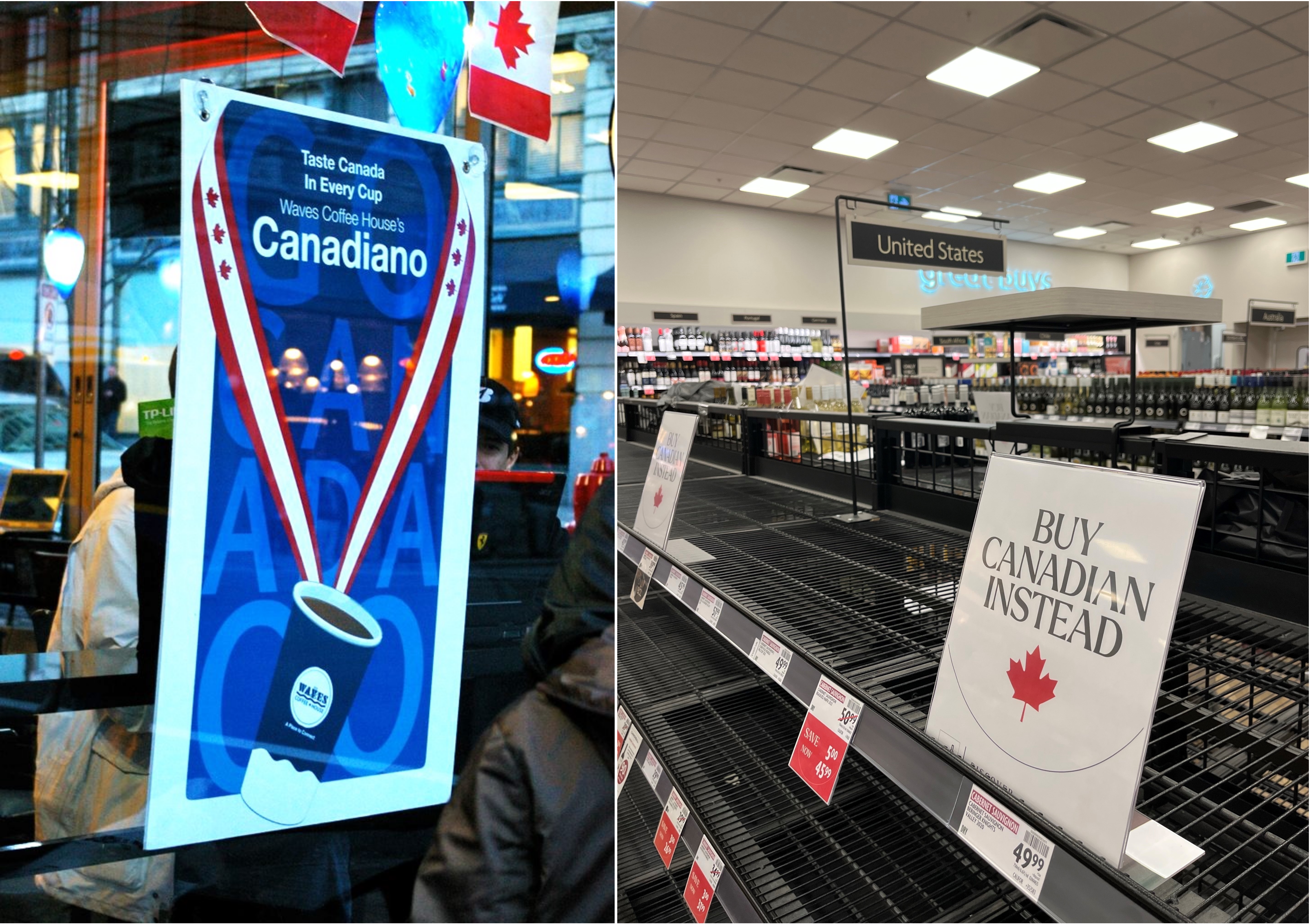
Such a posture might be emotionally soothing, but strategically it is weak. Liquor, produce and travel boycotts hit not only distant California and Kentucky but border states where people tend to love Canadians and oppose Trump’s tariffs – and whose Senators and Congressional representatives can often be counted on to lobby for smooth two-way trade and travel.
And while such posturing and signaling indeed is unserious, it’s hardly funny, because it’s seriously self-destructive. A Canada that cannot prevent tent cities from being normalized in its parks and underpasses should be cautious about congratulating itself on its moral superiority over the economic powerhouse it fundamentally depends on. At its weakest, “Elbows Up” becomes permission for lazy anti-Americanism – a way to feel brave without doing the harder work of rebuilding Canada’s own sources of strength. And it avoids the harder question: how did Canada become so structurally dependent on the U.S. in the first place?
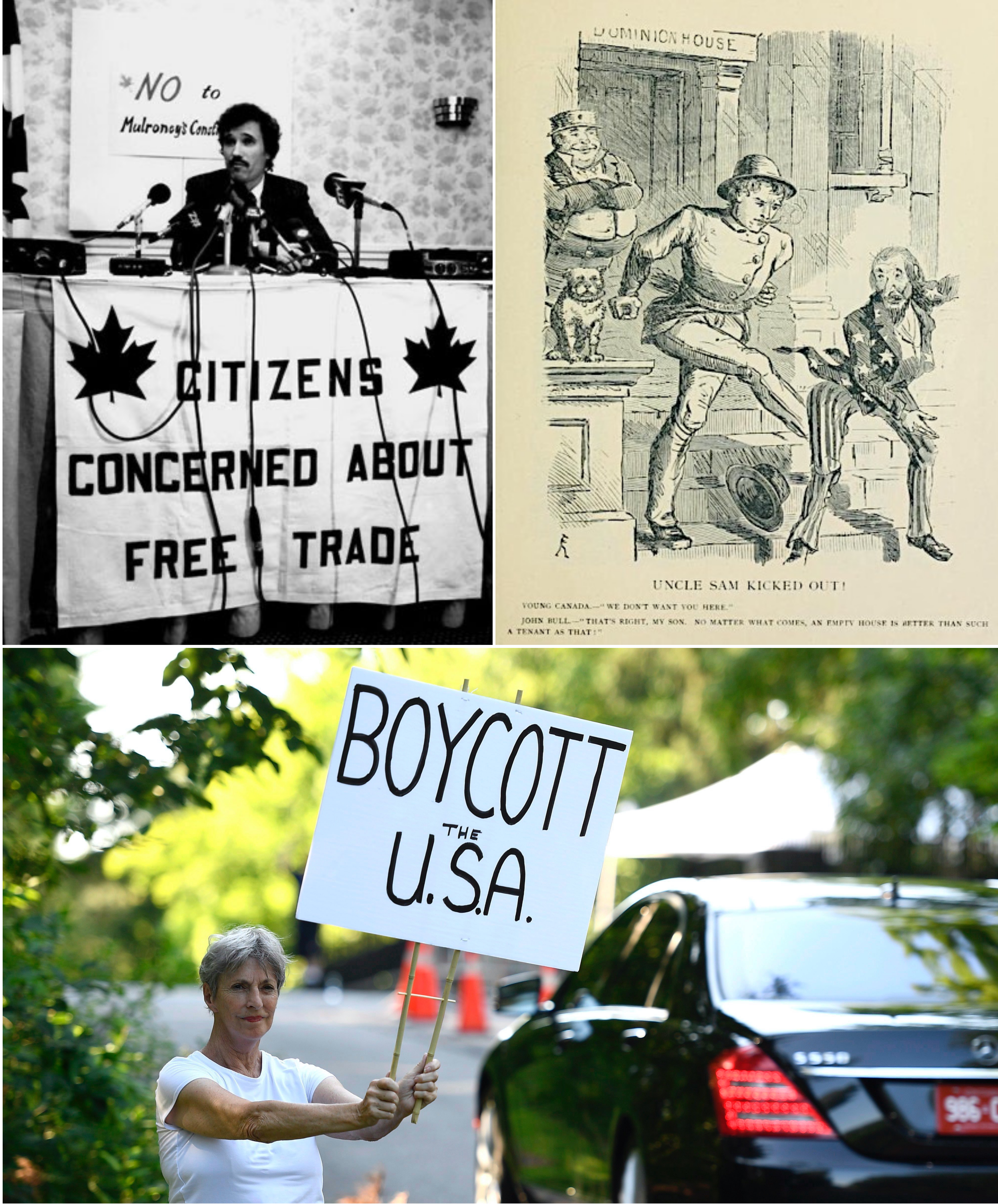
This pattern is not new. Canada has a long history of periodic temper-tantrums aimed at the Americans. Anti-Americanism predates Confederation itself. But that’s no justification for its indestructible recurrence; the opposite, actually. The anxieties of a small, infant country (1867 population: 3.4 million) sitting next to a chaotically evolving, aggressively expansionist behemoth against which it had fought the bitter War of 1812 – still within living memory – are understandable. Behaving the same way 150 years later, when Canada has more people than the entire U.S. did back in the 1880s, plus a $3.2 trillion annual GDP, isn’t understandable; it’s a sign of terminal immaturity, or maybe a collective psychiatric disorder.
How does the “Buy Canadian” movement reflect anti-Americanism and amount to economic self-sabotage?
The “Buy Canadian” movement that sprang up in response to U.S. President Donald Trump’s musings in 2024-2025 about making Canada the 51st state, like other forms of consumer boycott, harms Canadian businesses and consumers by restricting supply and reducing competition, reducing choice and raising domestic prices. This worsens Canada’s affordability crisis in a time of rising inflation and stagnant wages. Though presented as a morally praiseworthy form of patriotism, the U.S. boycott is an emotional response rather than a strategic one, diverting Canadians from beginning the harder work of rebuilding Canada’s own sources of strength. “Buy Canadian” is a manifestation of lazy anti-Americanism that mistakes symbolic distance from the U.S. for strategic independence.
But recur these tantrums do. There were spats in every decade following the World War II, sometimes more than one. The softwood lumber war in the early 1980s, then the debate over possible Canada-U.S. free trade in the late 1980s when the left, the media and about half the Laurentian establishment spent five years hollering, “They’re coming for our health care! They’re going to steal our water!!” No such thing happened, of course. But on it goes. As recently as 2018, Canada had another eruption of performative economic independence from the U.S., before quickly returning to its deeply integrated economy.
Canada and the United States will remain siblings by virtue of geography, integrated supply chains and – the unmentionable word – culture, whether they like it or not. Two-way trade last year fell to a “mere” $1 trillion in goods and another $300-$500 billion in services, but is growing again this year. With Mexico pushing hard for renegotiation of the three-nation free trade pact at the sight of patience wearing thin in the Trump Administration, the fracture is now a lot more worrying. Lazy nationalism even creeps into the treaty’s label. Is it USMCA, placing the member countries in descending order of population? No, it’s the CUSMA, because of Canada, beginning with a C!
Tantrums on repeat: Canada’s anti-American outbursts are older than the nation itself, with trade disputes and boycotts recurring virtually every decade. Shown: (top left) activist David Orchard opposing the impending North American Free Trade Agreement (NAFTA), September 1992; (top right) an 1869 cartoon expressing anti-annexation sentiment in Canada, captioned “Uncle Sam Kicked Out!”; (bottom) a protester calling for an American boycott at Lornado, the official residence of the U.S. Ambassador to Canada, Ottawa, 2018. (Sources of photos: (top left) Patrick Pettit/Regina Leader-Post; (bottom) The Canadian Press/Justin Tang)
Canadian anti-Americanism is not simply disagreement with U.S. policy. Mature disagreement could be useful. It might ask how Canada could become richer, stronger, more productive, better defended, less dependent and more capable. Instead, the lazy version is an alibi veiled in a cultural sneer. It allows Canada to avoid responsibility for its own stagnation and creeping decline. It lets Canada blame Trump, Republicans, American capitalism, American arrogance, American exceptionalism and American vulgarity. Canadians by implication are polite, refined, wise, moderate, enlightened and morally evolved.
The story is flattering – but also anaesthetizing. It allows a fraying country to milk the emotional pleasure of superiority without the burden of achievement. Washington is ever the villain while Canada is spared the painful question: why are we so dependent on a country we so enjoy resenting? Meanwhile, the harder domestic problems remain: weak productivity, low business investment, regulatory sludge, strangled markets, interminable and botched procurement, unaffordable housing and a political culture that rewards woke “virtue” over merit while subverting true patriotism.

The hypocrisy is difficult to miss with Canadian fans booing the “Star-Spangled Banner” at NHL and NBA games in Vancouver, Toronto and Winnipeg. Although some of that happened while Trump was behaving at his worst, just last month at the Canadian FIFA World Cup opening ceremonies, a sea of red and white paraded through Toronto’s streets – only for Canadian fans mere hours later to boo the American flag. This takes us multiple removes from policy critique into the realm of international humiliation and personal hostility toward ordinary people. It gets worse. A Quebec mayor found himself forced to beg Canadians not to boo American children at a peewee hockey tournament. If national self-respect requires grown adults to be reprimanded for jeering child athletes because of their passport, the politics curdled a while ago.
Mature Canadian patriotism would not confuse deracination with sophistication. It would not sneer at its own once-cherished traditions, desecrate public monuments or treat patriotism as shameful. It would not boo an anthem, eradicate Christmastime street decorations or forbid “God” from being spoken on Remembrance Day. It would build leverage. It would look at its own systems, institutions, resources and finances – and fix them. It would make Canada so productive, so innovative and so well-governed that talented people would not be forced to leave for anywhere else to flourish.
What would true Canadian self-determination look like, if Canadians were willing to move beyond performative anti-Americanism?
Mature Canadian self-determination involves building Canada’s own productivity pipelines, procurement systems, talent pathways and innovation infrastructure to make staying in Canada the obvious choice for its most talented citizens, innovators and entrepreneurs. It means substantively tackling – rather than just tweeting about – serious domestic problems like weak productivity, low business investment and excessive regulation. Such an approach could enable Canada to truly build leverage and strength, fostering a self-confident patriotism based on mutual respect for Americans, and improving Canada-U.S. relations through trade, interaction and alliance rather than emotional resentment.
None of this requires loving America uncritically or ignoring tariffs, insults or genuine threats to Canadian interests. It does require growing up. It requires distinguishing between the American government and the American people. It requires understanding that sovereignty is not a pose or a feeling, but a state of security and respect achieved through relentless work and competence.
Canada’s anti-Americanism is indestructible because it is emotionally convenient. It endures because it is immature. It is pretending that artificially induced emotional distance from the United States is the same as strategic independence from it.
Self-determination isn’t a grocery tag, slogan or renamed coffee. It’s the ability to build, defend, procure, trade, innovate and retain talent. To move goods within one’s own borders, to reward ambition, to attract capital and to make national independence amount to more than just one’s elbows twitching.
But while some Canadians keep busy policing grapefruit and strawberry labels for political impurity, many of the country’s most talented and ambitious continue to leave for the United States. They go to American universities, work for American companies, raise American capital and build American-headquartered firms. According to a study by Leader’s Fund, by 2024 a shocking 48 percent of start-up companies founded by Canadians were launched in the U.S.
The contradiction is devastating. If the United States is as crude and dysfunctional as Canadian anti-Americanism insists, why does it continue to achieve so much? Why does it remain such a powerful magnet for Canadian ambition?
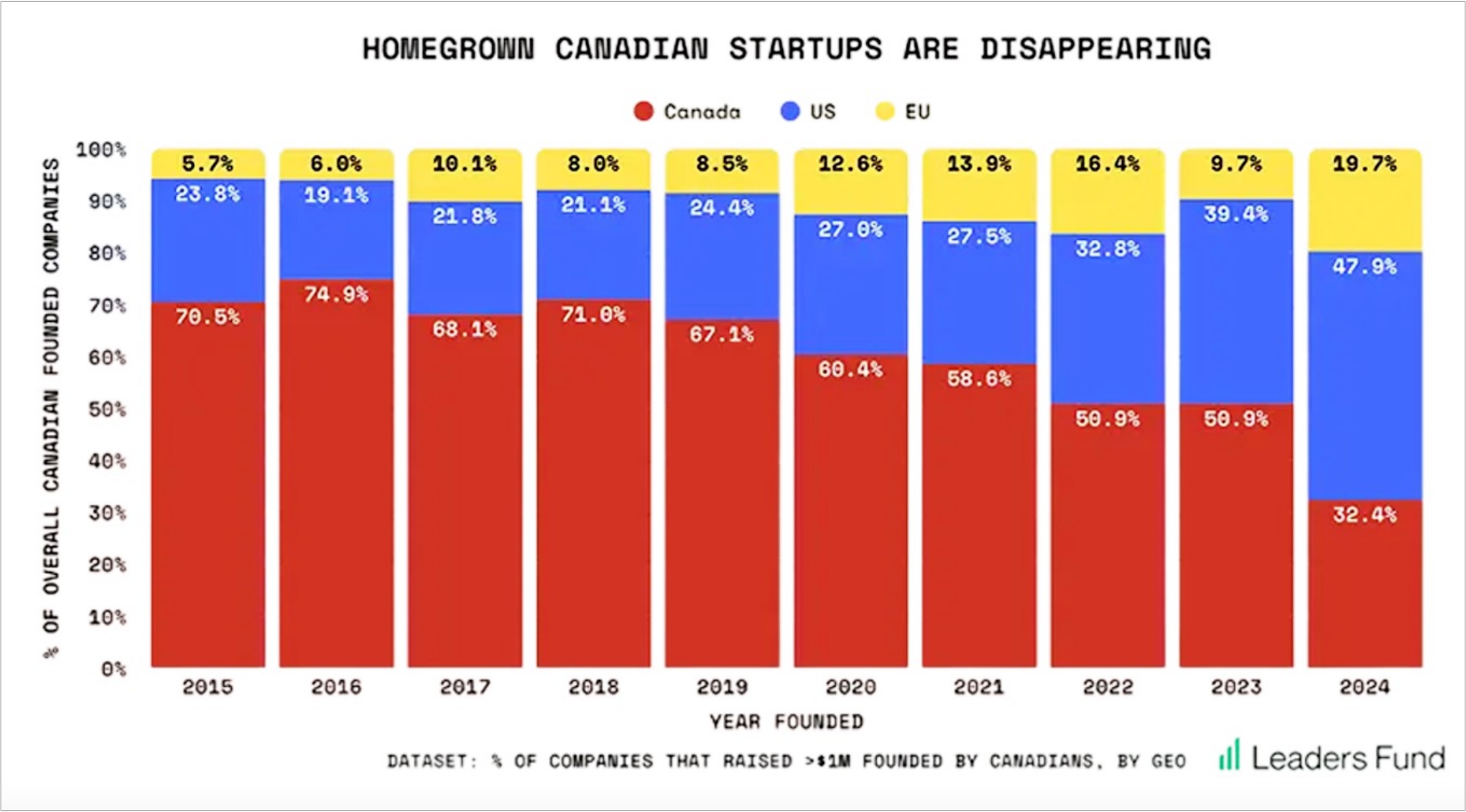
Self-determination isn’t a grocery tag, slogan or renamed coffee. It’s the ability to build, defend, procure, trade, innovate and retain talent. To move goods efficiently – and freely – within one’s own borders, to reward ambition, to attract capital and to make national independence amount to more than just one’s elbows twitching.
Mature sovereignty would mean a Canada that could defend its airspace, procure equipment on time, develop resources responsibly, move goods across and among its own provinces without obstruction, attract and retain founders, apply the rule of law blindly and equally, reward excellence through meritocracy and rebuild institutions that work for and protect its people. It would mean building a Canada secure enough not to sneer at Americans but to respect them instead. To trade with them, interact with them, maintain friendships and marriages with them, and stand shoulder-to-shoulder as allies when needed. Sovereignty wouldn’t be confusing.
Instead, confusion sprawls in all directions, from coffee to defence – a realm where cheap self-indulgent anti-Americanism suddenly becomes expensive and dangerous. Last year, Prime Minister Mark Carney ordered a review of the $19 billion contract for 88 American-made F-35 Lightning II stealth fighter jets, saying in part that Canada relied too much on the U.S. for security. This May, Reuters reported that the review was still incomplete, amid suggestions Canada might split its fighter fleet and buy some second-rate Saab Gripen jets.

There’s a legitimate argument for diversifying procurement and building more domestic defence capability. There’s a difference between strategic diversification and procurement as make-believe therapy, however. If Canada’s interminably delayed fighter-jet decision becomes just another opportunity to performatively distance from the United States, while actually degrading our air force’s capabilities, then anti-Americanism has moved from café menus into national security. Here too, confusion hardens into self-destruction when the establishment fires a respected defence official merely for pointing out the downsides of continuous anti-American rhetoric.
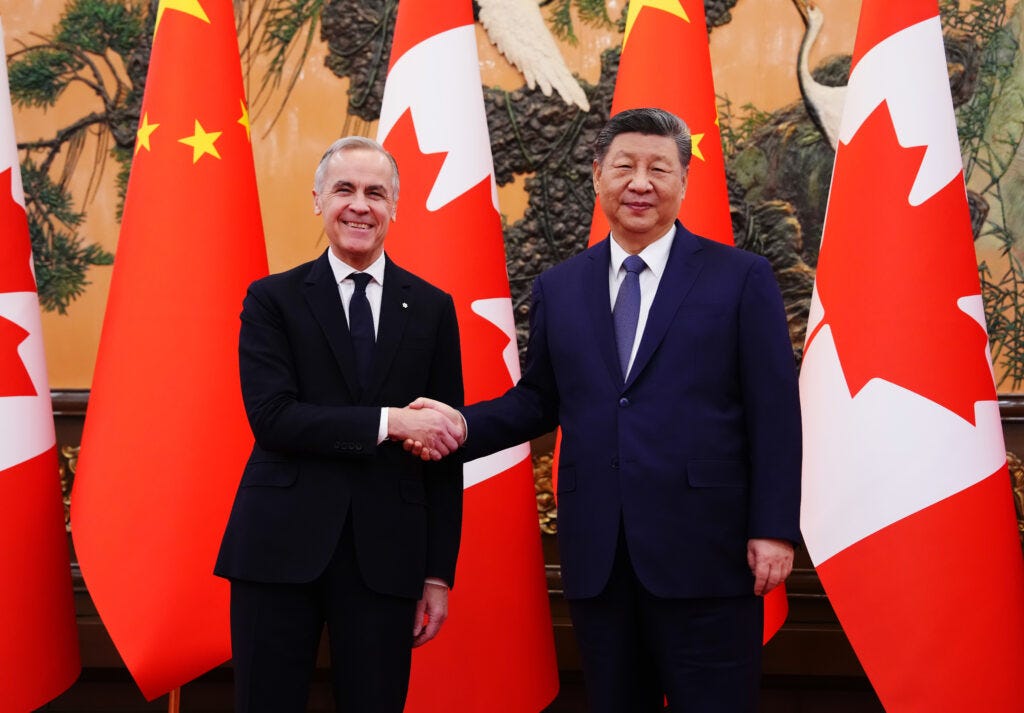
The China file is equally revealing. Diversifying trade is sensible and Canada should not remain helplessly dependent on one market. But a Canada that treats the United States as morally suspect while rushing to warm up relations with the cruel tyranny in Beijing is a flibbertigibbet country. In April 2025 Carney labelled China Canada’s most significant geopolitical threat; Canada’s foreign-interference inquiry had found China the most active foreign entity attempting to interfere in Canadian elections. Yet by January of this year Carney was in Beijing grovelling for stronger ties through closer cooperation. Again, diplomacy is important and some trade-offs are necessary, but the contrast is striking. The United States is treated as a bully to be culturally resisted, China a partner to be pragmatically managed. Selective indignation.
How does Canada’s approach to agreements like the trilateral free trade treaty known as CUSMA or USMCA reflect its immature stance on Canada-U.S. relations?
The common Canadian insistence on calling the United States-Mexico-Canada Agreement CUSMA rather than USMCA highlights a shallow form of emotional nationalism that diverts from genuine strategic planning and policy execution. It reflects an immature, resentful anti-Americanism that is poisoning relations, prioritizing symbolic gestures and performative nationalism over genuine efforts to strengthen the economy and address structural dependencies. This posturing allows Canada to avoid responsibility for its own stagnation by blaming America, rather than confronting its genuine problems by working to rebuild true strength.
Our federal government has proved unserious even in its anti-Americanism. The apotheosis of puffed-up posing – as well as a sure vote-getter – was the government’s “Buy Canadian” push. The plain and ordinary meaning of such a slogan is that the Government of Canada would promote, designate and/or purchase things that were actually made, grown or otherwise produced in Canada. Not quite. Months later, bureaucrats questioned by Opposition MPs reluctantly admitted that literally any “presence” in Canada qualified as Canadian content, even a mere warehouse or storefront containing 100 percent foreign-made goods. Then there is the “Canada Strong Pass” ostensibly aimed at making it more affordable for citizens to enjoy our national parks – only to see them more overrun than ever with foreign tourists chasing deals.
Broad anti-Americanism becomes self-defeating when Canada’s economy, talent pipelines, innovation ecosystem, tourism flows, capital markets and startup ambitions remain deeply integrated with the United States. A contradiction that anti-Americanism cannot explain: if America is so stupid, why do so many of our smartest and most driven people go there to flourish?
The answer isn’t that America is perfect. America is chaotic, aggressive, unequal, loud and exasperating. But it is also dynamic. It rewards ambition. It absorbs talent. It builds at scale. It fails spectacularly and renews itself in perpetuity. Canada, by contrast, specializes in over-governing its over-regulated markets, making ambition so reviled that hating Elon Musk is the latest of its virtues. Meanwhile, the Ontario Teachers’ Pension Plan profits to the tune of $11.6 billion from the initial public offering of Musk’s SpaceX. In an ironic twist, Musk, whose mom is Canadian and who spent time living and studying in Canada, went to the U.S. for his project to take the fiction out of science fiction, and now presides over American companies valued at a scale that Canada itself struggles to imagine.
So while some Canadians satisfy their wilted ambitions in declaring Florida orange juice morally off-limits, ever-more of our country’s most ambitious look south. A study of brain-drain by Brock University reported that many science and technology graduates were heading to the U.S. and only two of the top ten employers of Canadian tech-degree graduates who did stay were Canadian.

Canada can posture against the United States culturally, but its most ambitious builders often still look south for capital, scale, compensation and company formation. Tellingly, the wording in that Leader’s Fund study cited above had shifted from “We invest in Canada” in previous editions to “We invest in Canadian founders, wherever they build.” Canadian company founders raised nearly twice as much capital in the U.S. as those based in Canada, while Better Dwelling found that fewer than one-third of Canadian-educated founders launched in Canada.
Canada’s problem is not that it likes America too much. It is that it resents American power while exporting the people most capable of building Canadian power. The damage done by this nation’s self-sabotage is not only that talent leaves, it’s that Canada fails to fully utilize the talent it already has. It watches ambition migrate elsewhere and then congratulates itself for not being American.
Meanwhile, a Canadian founder will quietly board a flight to San Francisco because they dared to dream, knowing that even if they fail they will learn more than they ever would from stay-at-home compliance. And if they succeed, not even the sky will be the limit.
Resurrecting Canadian self-determination would mean building its productivity pipelines, procurement systems, talent pathways and innovation infrastructure so that staying in Canada became the obvious choice. It would mean looking honestly at Canada’s problems of crowding-out the private sector, smothering regulations where the only “fix” is more regulation, virtue-signaling industrial policies, abysmal productivity, chronically low investment and flatlining GDP. It would focus on fully exploiting its most competitive assets for revenue-generation: oil, natural gas, mines and other natural resources. Yet the Bank of Canada and much of Bay Street remain in blissful denial of our country’s economic stagnation, reported elsewhere as stupefying, shocking and unsustainable.

A serious country would want better. It would want less theatre and more capability. Less resentment and more achievement. Less maple-leaf moralism in the grocery aisle, and more of the hard, unglamorous work required to make Canada strong, respected, resilient and wealthy, where life is once again affordable. Until then, someone will rename a drink and feel patriotic about it. In some other grocery aisle a shopper will study a package for the coveted maple leaf and mistake the purchase for an act of conscience. Others will boo an anthem at a hockey game and imagine they are defending national sovereignty. Others will stamp their feet in protest and cancel a planned trip to the United States.
Meanwhile, a Canadian founder will quietly board a flight to San Francisco because they dared to dream, knowing that even if they fail they will learn more than they ever would from stay-at-home compliance. And if they succeed, not even the sky will be the limit. I myself am a start-up tech founder – and I am in the process of incorporating my company in the U.S. Somewhere else, a Canadian consumer will stare at a pitiful bundle of celery and wonder how a country so abundantly rich became small enough to mistake sourcing a different stalk for national strategy.